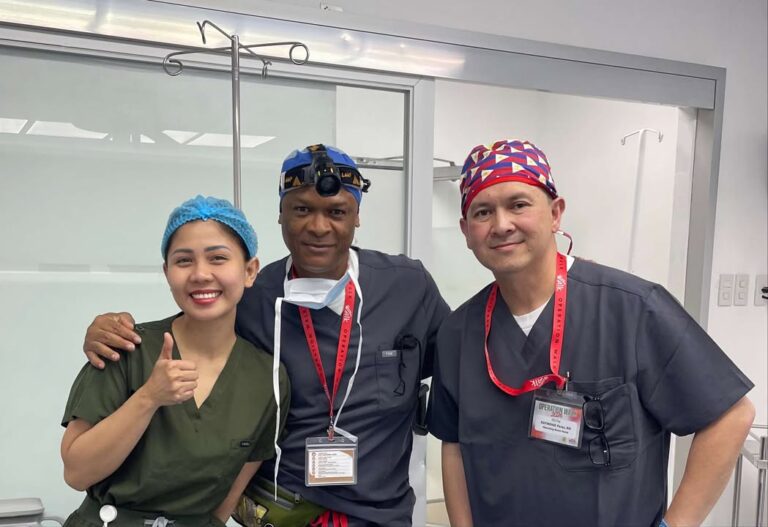
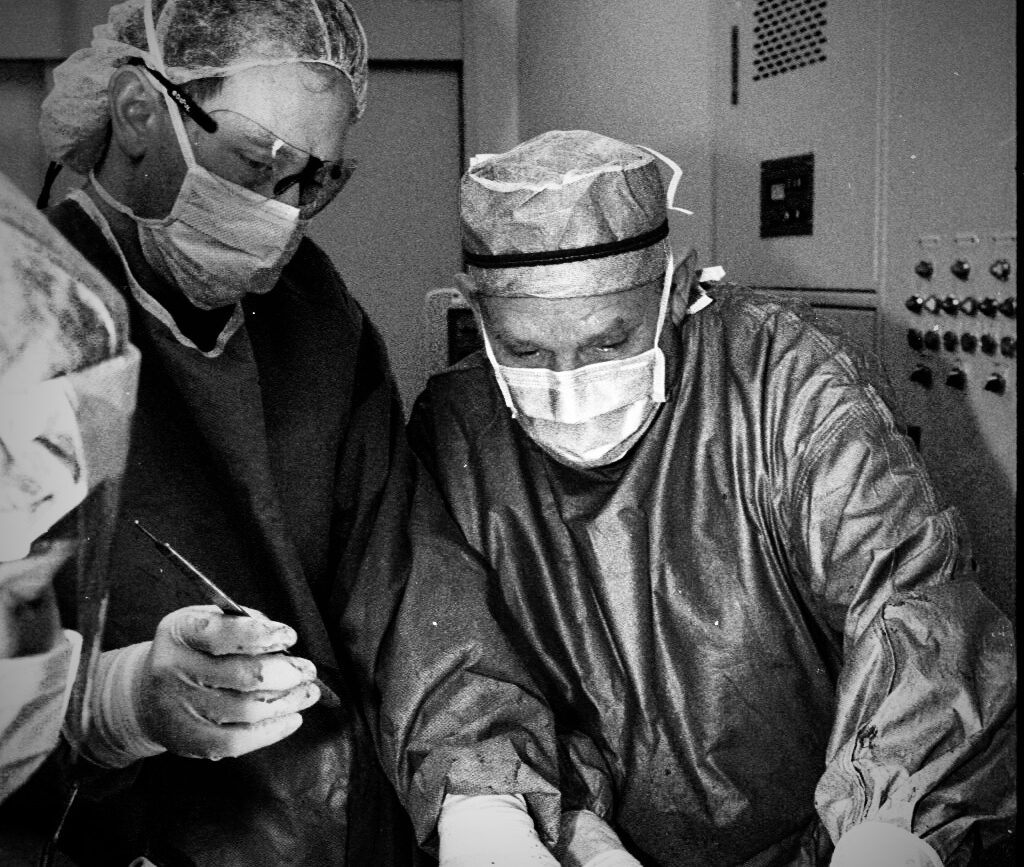
When I think back to that mission in 2001, I am reminded of how our location proved to be full of challenges. The hospital in Cebu had double-booked themselves for medical missions. A team of neurosurgeons were using the ORs, so we ended up using little outpatient exam rooms for surgery.
We placed OR tables diagonally to fit the cramped quarters. The scrub tech had to go in first with the instruments and then the bed with the patient – sealing in the tech. We taped sterile drapes to the wall because the instrument tables were right up against it. You can visualize how small the room is since Dorr is right up by the wall. Pre-op and post op were in what was the waiting room of the clinic. Patient rooms were set up in the lobby of the hospital with chalkboards as room dividers in the area where they typically did peritoneal dialysis.
Another obstacle was the power. During a surgery I was observing, the power went out for 20 minutes and there was no generator. I had to make use of my Surefire tactical flashlight so Dorr could see to operate. The elevators were also extremely unreliable. Jeri Ward, our Director, was caught in an elevator with temperatures in the triple digits. There were no emergency buttons to call the fire department; she just had to wait it out until the power came back on.
I remember the people being committed to one another, making do with so little. There weren’t any wheelchairs available, and patients were carried piggyback by relatives. The level of poverty was astounding.
The typical care for a hip fracture was traction. If the fracture was through the top of the femur, the area that is wider and more likely to heal, a pin was placed through the top of the tibia, below the knee and twine was wrapped around it. That twine was attached to an old antifreeze jug filled with sand or a collection of pipe elbows – depending on how much weight was needed and what was on hand. The jug was tossed over the end of the bed to act as traction. After about a month, they would start moving the leg a bit and when it no longer hurt, they took off the traction, pulled out the pin and sent them on their way without an x-ray to see how it had healed. That was the best-case scenario. If the initial X-ray showed a fracture in the neck of the femur, there was nothing to be done. Those patients were sent on their way.
That mission made me appreciate what we have here at home in the United States, but I think that is true of all Operation Walk missions. It also reinforced, in those early years, that we could rely on one another to pull through, no matter the conditions we faced. Even though our environment was austere, we provided surgeries for patients who didn’t have access to joint replacement. That is always the final goal.